The War Vote Receipt
Congress got a chance to reclaim the war power. The Senate handed it back.
The vote was procedural. The consequence was not.
“The vote was procedural. The consequence was not.”
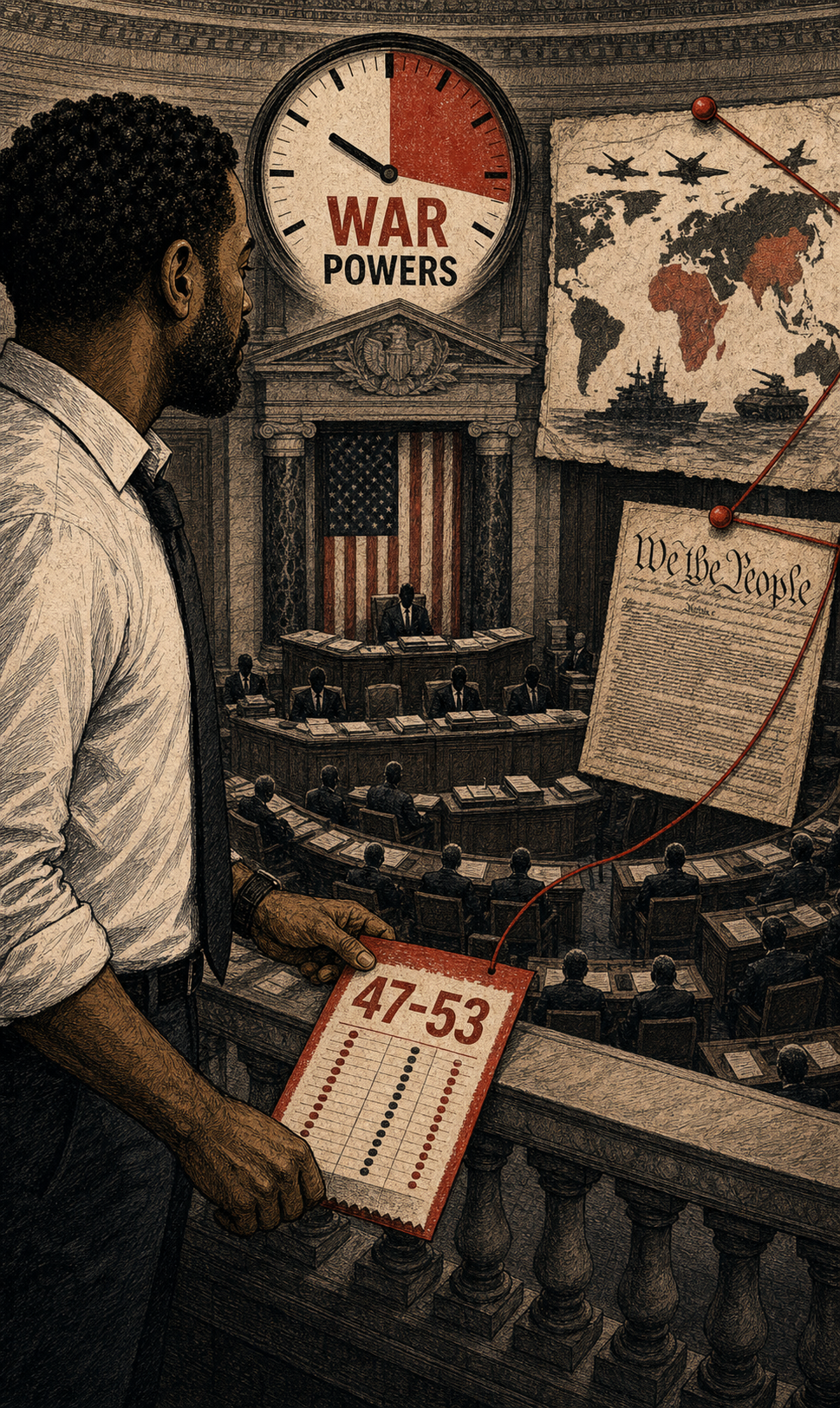
The full report is below, archived here with the public receipt trail, source ladder, and reader actions intact. Every claim below clears at two-of-three independent sources before publication, with right-of-reply offered to every named subject.
I have heard politicians praise the Constitution right up until the Constitution asks them to vote.
That is the thing about war power. Everybody loves Congress’s role in theory. Everybody loves checks and balances in speeches. Everybody loves the founders when the founders are safely dead and not asking anyone to take a hard vote before dinner.
Then the roll call opens.
On March 4, 2026, the Senate had a chance to move forward on S.J.Res.104, the Iran War Powers Resolution led by Tim Kaine and Rand Paul. The motion failed 47-53. Rand Paul was the only Republican to vote yes. John Fetterman was the lone Democratic no.
They said Congress matters. Then 53 senators voted like it did not.
The Machine
War power is where cowardice dresses up as seriousness.
Nobody wants to look soft. Nobody wants to sound naive. Nobody wants the attack ad. So the Senate finds a softer word: procedure, motion, discharge, hostilities, authorization. The language gets smaller as the stakes get larger.
That is the machine. It turns the biggest question a republic can ask into a procedural vote normal people are not supposed to understand.
Should one president be able to keep the country in hostilities against Iran without explicit congressional authorization? That was the question hiding inside the wrapper.
The Receipts
- The official clock. The U.S. Senate Daily Press recorded that at 5:23 p.m. on March 4, the Senate did not agree to the motion to discharge S.J.Res.104 by a vote of 47-53. It also recorded the two crossover facts: Paul voted aye and Fetterman voted no.
- The resolution. The Senate Democratic schedule described S.J.Res.104 as a joint resolution to direct the removal of U.S. armed forces from hostilities within or against Iran that had not been authorized by Congress.
- The public argument. Kaine, Schumer, and Schiff said the resolution would have stopped Trump’s illegal, unnecessary war with Iran and ensured U.S. participation in hostilities be explicitly authorized by Congress.
- The reporting. NOTUS reported that Senate Republicans blocked the effort to curb Trump’s war powers on Iran, giving him the go-ahead to continue a deadly military campaign without congressional approval.
- The quote that indicts the vote. NOTUS quoted Lisa Murkowski after she voted against the resolution: “I don’t want today’s vote to be interpreted that I don’t think that Congress has a role. Not by a long shot.”
The role exists. The vote said otherwise.
The Translation
The Senate did not vote on a poem. It voted on power.
Who gets to decide whether American forces stay in hostilities? Who has to explain the objective? Who has to define the exit? Who owns the consequences when the war expands, the costs rise, the retaliation comes, the contractors line up, and the body count becomes a number everybody learns too late?
Congress loves oversight after the fact: after the strike, after the escalation, after the classified briefing, after the first bad headline, after the vote can be called complicated.
But war power was not supposed to work like a reimbursement form. Congress does not get to become brave in the footnotes.
Read The Receipts Before The Spin
- U.S. Senate Daily Press for the clean vote record and crossover note.
- Sen. Tim Kaine for the sponsors’ public case.
- Hamed Ahmadi at NOTUS for the reporting frame and Murkowski quote.
- Senate Democratic Caucus for the procedural wrapper around the actual war-power question.
The Verdict
Do not let them hide behind procedure.
The vote was procedural. The consequence was not.
Fifty-three senators voted to let one man keep the war without forcing Congress to own the decision clearly. They can say they believe Congress has a role. The roll call says what role they were willing to play.
That is the receipt. And receipts do not salute.
This one is built to forward.
Drop your email and the next receipt lands where you can actually use it.
Receipts in this issue
Already on the list? Send this to one person who reads the fine print.
New here? Subscribe from this issue so the dashboard can count the public funnel, not just imports.