THE 51: Every Senator Who Voted To Bury The Epstein Files
Every senator who voted to bury the Epstein files, archived from the published Beehiiv issue.
The list matters because the vote was the receipt. Every name belongs on the public page.
The full report is below — also published on Beehiiv — with its receipt trail and source ladder. Every claim below clears at two-of-three independent sources before publication, with right-of-reply offered to every named subject.
Washington — On a Tuesday afternoon in early September, with most of the capital still distracted by the annual budget standoff and the tail end of a long recess, the United States Senate held a vote that almost no one was watching. The gallery was sparse. The amendment had been expected to fail. It failed. But “failed” is an incomplete word for what happened on September 10, 2025, when fifty-one members of the United States Senate voted to table Senate Amendment 3849 — a measure that would have directed the Justice Department to release, within thirty days, every unclassified document in federal possession relating to Jeffrey Epstein. The amendment died. Senate Roll Call Vote 119-1-512 did not.
This investigation names all fifty-one senators who cast that vote. It cross-references every name against the publicly disclosed contribution history of Leslie H. Wexner — the New Albany, Ohio billionaire who was identified in DOJ-released FBI documents in February 2026 as a co-conspirator of Epstein. It documents three financial receipts totaling $7,000 to two Ohio senators in the 2025 cycle alone, traces one institutional channel that moved another $250,000 through the committee that re-elects Republican senators, and records the silence that has followed every Epstein document release in the seven months since the vote. The Senate roll call is public record. The FEC filings are public record. The Wexner deposition is public record. The silence is observable by its absence. None of what follows is alleged. All of it is documented.
Senate Amendment 3849 was sponsored by Minority Leader Chuck Schumer and attached to the National Defense Authorization Act. Its language was precise and deliberately narrow: direct the Attorney General to make publicly available, within thirty days, every unclassified record, document, communication, and investigative material in the possession of the Department of Justice relating to Jeffrey Epstein and his associates. The amendment did not require charging anyone. It did not prejudge guilt. It did not open sealed proceedings. It asked, in the plainest possible statutory language, for the government to show the public what it had collected over more than a quarter century of federal investigation.
The Senate voted to table it — not to amend, not to delay, but to kill it without further debate and return to the underlying defense bill. The motion to table carried 51–49. All 47 Democrats voted against tabling. Forty-nine Republicans voted to bury the documents. Two Republicans, Rand Paul of Kentucky and Josh Hawley of Missouri, broke with their conference to vote no. Zero Democrats crossed the other way.
Forty-nine Democrats voted to release. Forty-nine Republicans voted to bury. Two Republicans crossed. Zero Democrats crossed.
This is not a both-sides story. It is a party-line burial, with two exceptions. The question at the center of this investigation is the same question it has always been: why those forty-nine, and why that particular vote, and what, if anything, connects the senators who cast it to the man whose documents they voted to keep sealed.
Senate Roll Call Vote 119-1-512 · September 10, 2025 · Motion to Table Amendment 3849
Banks (IN) · Barrasso (WY) · Blackburn (TN) · Boozman (AR) · Britt (AL) · Budd (NC) · Capito (WV) · Cassidy (LA) · Collins (ME) · Cornyn (TX) · Cotton (AR) · Cramer (ND) · Crapo (ID) · Cruz (TX) · Curtis (UT) · Daines (MT) · Ernst (IA) · Fischer (NE) · Graham (SC) · Grassley (IA) · Hagerty (TN) · Hoeven (ND) · Husted (OH) · Hyde-Smith (MS) · Johnson (WI) · Justice (WV) · Kennedy (LA) · Lankford (OK) · Lee (UT) · Lummis (WY) · Marshall (KS) · McConnell (KY) · McCormick (PA) · Moody (FL) · Moran (KS) · Moreno (OH) · Mullin (OK) · Murkowski (AK)¹ · Ricketts (NE) · Risch (ID) · Rounds (SD) · Schmitt (MO) · Scott Rick (FL) · Scott Tim (SC) · Sheehy (MT) · Sullivan (AK) · Thune (SD) · Tillis (NC) · Tuberville (AL) · Wicker (MS) · Young (IN)
Highlighted: direct Wexner contributions or NRSC institutional exposure (see below). ¹Murkowski co-signed the bipartisan DOJ IG audit demand, December 2025 — the only Republican to do so. Source: senate.gov.
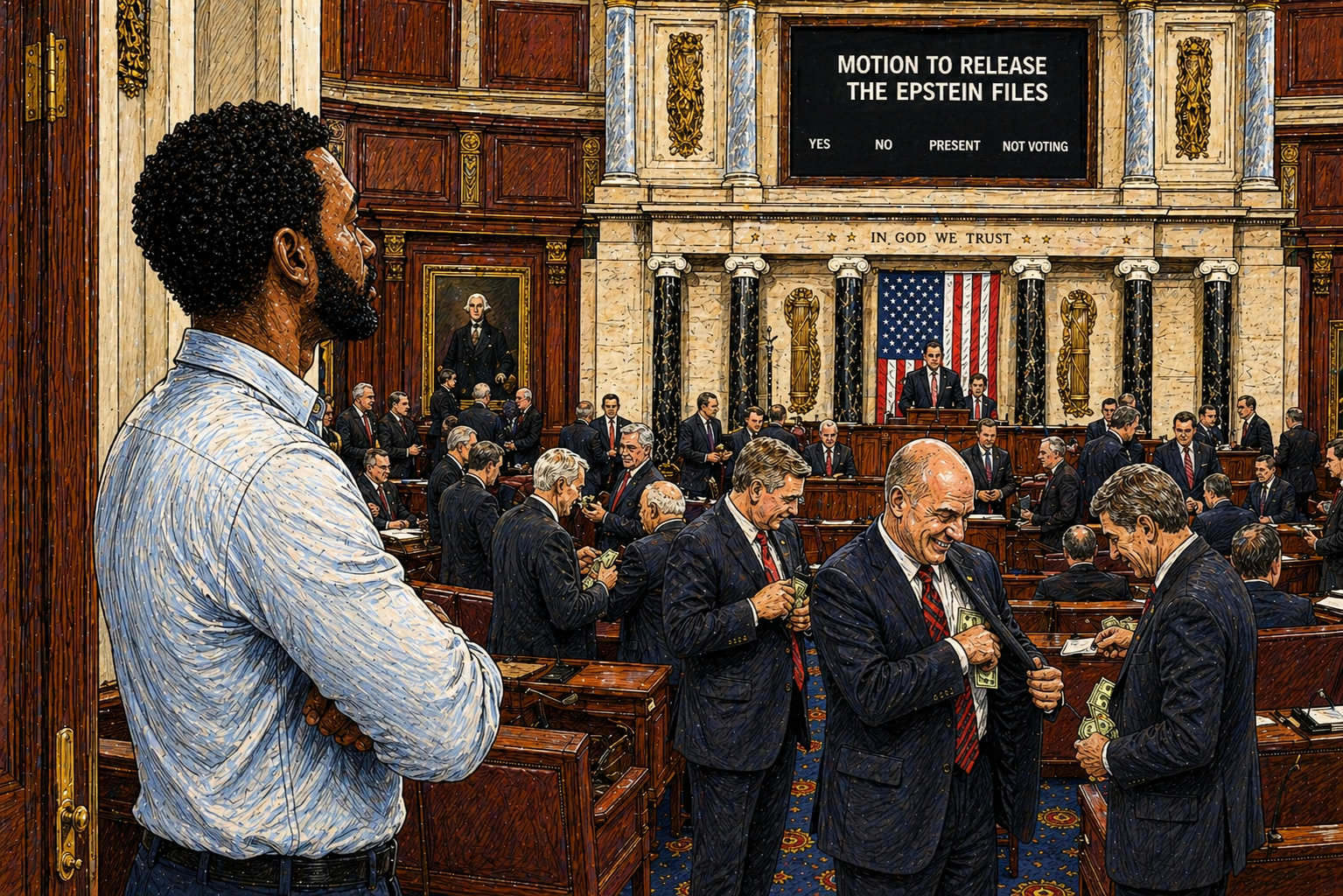
The two Republicans who crossed represent a specific strand of the modern party — one that the party’s donor class has historically treated with wariness. Rand Paul of Kentucky has spent a decade building an identity around government transparency that predates Trump and does not depend on him. His vote against tabling the Schumer amendment was consistent with a decade of civil liberties votes. Josh Hawley of Missouri is a different kind of disruptor: a populist whose brand is performing independence from the very establishment he serves alongside. Cynicism about that brand is available. The vote is the record regardless.
What the Paul-Hawley crossover most clearly documents is the cost of crossing. Forty-nine Republican senators — including senators who have publicly condemned Epstein, who have called for accountability, who have posted about the files on social media — chose not to pay that cost on September 10. The question this investigation is designed to answer is whether there is a documented financial relationship between the senators who voted to bury Epstein’s files and the man the FBI named as Epstein’s co-conspirator. There is. It follows.
The Wexner Crosswalk
Leslie H. Wexner is the founder and former chief executive of L Brands, the Columbus, Ohio-based retail conglomerate that owned Victoria’s Secret and Bath & Body Works. He is, by most measures, the most politically active major donor in Ohio history: nearly $750,000 across at least thirty-nine political campaigns or groups since 2019 alone, per NBC4 Columbus reporting and FEC filings. He is also, as of February 2026, a named co-conspirator of Jeffrey Epstein in DOJ-released FBI documents. His lawyers dispute the characterization. The documents do not. Per his own sworn deposition in the U.S. Virgin Islands v. JPMorgan civil suit, Epstein served as his money manager, held power of attorney over his affairs, and operated inside his personal orbit for years before Epstein’s 2008 arrest on state sex-trafficking charges. The deposition contains dozens of instances of the phrase “I don’t recall.” The FBI documents do not share his uncertainty.
|
№01 |
Sen. Jon Husted (R-OH). $3,500. July 3, 2025. Sixty-nine days before the vote. On July 3, 2025 — ten weeks before the Senate vote — Wexner contributed $3,500 to Husted for Senate, documented in FEC filing C00896019. It was not the first check; per Wexner’s own sworn deposition and FEC career data reported by Snopes, his career contributions to Husted total $116,892 across twenty-four years. Sixty-nine days after that check cleared, Jon Husted voted to table Senate Amendment 3849. When Ohio reporters raised the contribution, Husted’s camp offered a response: he would donate the $3,500 to charity. That is not the same as returning it. The three questions this investigation is formally sending to every senator on the list ask whether each senator will return Wexner-network money to the Treasury of the United States — not to a charity of the senator’s choosing. Donating to a charity Husted selects is a reputation-management decision. Returning money to the public treasury is an accountability decision. His camp offered the former. The question requires the latter. The full $116,892 career total is intact. Source: FEC C00896019; Snopes 2026 fact-check; Tiffin Ohio reporting. |
|
№02 |
Sen. Bernie Moreno (R-OH). $3,500. Same cycle. Refused to return it. The same cycle, the same donor. Wexner contributed $3,500 to Bernie Moreno for Ohio in 2025. Moreno voted to table Senate Amendment 3849. When NOTUS and ABC6onyourside reported the contribution, Moreno’s camp described the donation as “unsolicited” — a characterization a source familiar with the situation confirmed to NOTUS. The donation remains in his account. He has refused to return it. The “unsolicited” framing is worth a moment’s examination: federal election law does not require a campaign to solicit a contribution before depositing it. The decision to keep a contribution from a man named in FBI documents as an Epstein co-conspirator — after that naming became public, after the contribution was reported — is not an oversight. It is a decision made with full information. It is in his account. Source: FEC; NBC4 Columbus; Signal Ohio; NOTUS. |
|
№03 |
The institutional channel. $250,000 to the NRSC. One cycle. Beyond the two direct contributions, Wexner gave $250,000 to the National Republican Senatorial Committee in 2025, per FEC filings and Signal Ohio reporting. The NRSC is the institutional vehicle for Republican Senate campaigns nationally — it funds polling, advertising, opposition research, and ground operations for Republican races in every competitive state. This is the institutional channel through which donor money achieves scale without individual accountability. A direct contribution to a senator’s campaign is traceable to that senator. A contribution to the committee that runs the senator’s party creates a layer of distance — the senator can truthfully say they received no direct Wexner contribution — while the financial relationship continues. Senate Majority Leader John Thune (SD), Senate Republican Leader Emeritus Mitch McConnell (KY), Senate Appropriations Chair Susan Collins (ME), and 2026 reelection bellwether John Cornyn (TX) are among the senators on the list who carry NRSC institutional exposure from that $250,000. Source: NRSC FEC filings; Signal Ohio. |
The Number
$256,500
Directly-traceable Wexner-to-Senate spend, 2025 cycle alone.
$3,500 to Husted · $3,500 to Moreno · $250,000 to the NRSC.
One donor. One cycle. Fifty-one votes.
The senators who voted to keep the Epstein files sealed did not, ultimately, keep them sealed. The Epstein Files Transparency Act (H.R. 4405), passed in November 2025, forced an initial DOJ document release on December 19. That release was immediately condemned — by senators from both parties and by civil liberties advocates — for redactions so extensive they violated the plain text of the law. On December 24, DOJ disclosed “another million pages” of Epstein documents. On January 30, 2026, DOJ released a further three million pages. In February, those documents included the FBI records naming Wexner as Epstein’s co-conspirator — the records that retroactively charged every FEC entry in Wexner’s contribution history with new relevance. In March 2026, a bipartisan group of senators demanded an independent audit of DOJ’s release process. Sen. Ron Wyden of Oregon has continued releasing analysis of JPMorgan Chase executives’ alleged enabling of Epstein’s trafficking operation into 2026.
The arc of that timeline clarifies exactly what the September 10 vote accomplished. The senators who cast it did not prevent the documents from existing. What they did was delay, by several months, a release process the public had been demanding for years — a delay that happened to include a period during which Wexner continued donating to their campaigns and their party committee. That the documents eventually came out, partially, with disputed redactions, does not close the question of who used their institutional power to slow that process, or what their financial relationships were when they used it.
Of the fifty-one senators on this list, one has subsequently taken a public action that partially distinguishes her from the forty-nine who have not. Sen. Lisa Murkowski of Alaska voted to table Senate Amendment 3849 on September 10, 2025. Three months later, in December, she co-signed the bipartisan letter to DOJ requesting an independent inspector general audit of the Epstein files release — the only Republican senator to do so. Murkowski’s co-signature does not undo her September vote. The roll call is what it is. But it is worth noting precisely because it is singular: of the forty-nine Republicans who voted to bury the files, only one has since put her name on any public accountability document about those files. The September vote is still the record. The December flip is the tell — not because it exonerates her, but because its singularity indicts the forty-nine who have done nothing at all.
There are very few issues on which the populist American left and the populist American right have agreed in the past decade. The release of the Epstein files is one of them. The MAGA grassroots have spent four years demanding the documents. The Sanders-aligned grassroots have spent the same four years demanding the same documents. The survivors of Epstein’s trafficking network have spent twenty years demanding them. They are not asking for the same reasons. They are asking for the same files. On September 10, 2025, the United States Senate had the cleanest possible opportunity to give them those files, and fifty-one senators voted not to. The bipartisan demand for accountability is the context in which the party-line burial happened. The receipts are the reason it matters that it did.
The reason this crosswalk had not been assembled in one place before today is not that the data is difficult. The Senate roll call is publicly available at senate.gov. The FEC filings are at fec.gov. The Wexner deposition is part of the public record of the U.S. Virgin Islands v. JPMorgan civil suit. Snopes published a definitive fact-check on the Husted-Wexner connection. Signal Ohio documented the Ohio political class. The only thing that had not been done was placing all fifty-one senators in one column and running them, systematically, against the Wexner ledger. That is what this investigation did.
Questions for the Record
I am sending the following three questions, on the record, to every senator on the list above. I will publish every response received within thirty days, in full. I will publish every non-response, in full. A senator who can answer all three questions cleanly has nothing to fear from this list. A senator who cannot is on it for a reason.
1. What is the total dollar amount of contributions you, your campaign committee, your leadership PAC, your joint fundraising committee, your spouse, or any entity controlled by your immediate family has received, in any election cycle, from Leslie H. Wexner or any entity directly controlled by Leslie H. Wexner?
2. Do you commit, on the record, to returning every dollar of that money — not to charity, not to a survivor’s nonprofit, but to the Treasury of the United States — within thirty days of receipt of this question?
3. Will you publicly join the bipartisan group of senators currently demanding an independent audit of the Department of Justice’s redactions in the Epstein-files release process?
The distinction embedded in question two is not a technicality. When Husted’s camp announced he would donate the Wexner money to charity, they answered a question that was not asked. Donating to a charity of the senator’s choosing is a decision about reputation management. Returning money to the public treasury is a decision about accountability. They are different acts with different meanings, and the choice to offer one while the question requires the other is itself a data point.
In the seven months since September 10, 2025, not one of the fifty-one senators on this list has issued a substantive on-the-record public statement addressing the relationship between their own Wexner contribution history and their vote to bury the Epstein documents. Several have continued to receive Wexner-network contributions in subsequent quarterly FEC filings. None has returned a check. None — with the single exception of Murkowski’s IG audit co-signature — has joined any public accountability effort relating to the Epstein files.
The silence is not incidental. It is the most legible data point this investigation produced. A senator who voted against releasing the files and has since said nothing has, in that silence, said something. The absence of a statement is a statement. The absence of a returned check is a financial position. The absence of a name on the audit letter is a vote, cast in the negative, every day it goes uncorrected.
If the answer is no, say no.
If the answer is yes, resign.
If the answer is silence,
the silence is the answer.
Methodology & Sources
Senate vote: Roll Call Vote 119-1-512, September 10, 2025 (senate.gov).
Wexner contributions: FEC filing C00896019 (Husted for Senate); NRSC FEC filings; NBC4 Columbus; Signal Ohio; Wexner sworn deposition, U.S. Virgin Islands v. JPMorgan Chase, N.A. (S.D.N.Y. 2024); Snopes 2026 fact-check.
Moreno: NOTUS (source confirmed); ABC6onyourside Columbus.
Wexner co-conspirator identification: DOJ-released FBI documents, February 2026 (NBC News, ABC News, CNN). Wexner’s representatives have disputed the characterization.
Murkowski: murkowski.senate.gov; merkley.senate.gov; Senate Judiciary Committee press release, December 2025.
Document timeline: H.R. 4405, November 2025; DOJ December 19, 2025 and January 30, 2026 releases; bipartisan audit demand, March 2026.
This investigation makes no claim that any senator personally knew Jeffrey Epstein, appears in any sealed Epstein proceeding, appears in the flight logs, or had direct knowledge of Epstein’s conduct. It makes no claim of quid pro quo between any contribution and any vote. It reports the public record: the roll call, the FEC filings, and the absence of any on-the-record statement addressing the connection between the two. Every claim above is sourced. The vote is arithmetic. The money is arithmetic. The silence is arithmetic.
This one is built to forward.
Drop your email and the next receipt lands where you can actually use it.
Already on the list? Send this to one person who reads the fine print.
New here? Subscribe from this issue so the dashboard can count the public funnel, not just imports.