She Gave the Speech After the Bullets
I was supposed to be at the WHCD. I watched it become a security incident from my couch. What Weijia Jiang said when she came back to the stage at 9:39 PM — off-script, in a building still being cleared, with the room on the floor — is the speech 250 journalists asked for. CBS still sat Hegseth at its table.
Karoline Leavitt joked about 'shots fired in the room' on the red carpet. Twenty minutes later it wasn't a joke. The dinner ended on the floor. The speech happened anyway.
The full report is below, archived here with the public receipt trail, source ladder, and reader actions intact. Every claim below clears at two-of-three independent sources before publication, with right-of-reply offered to every named subject.
The Saturday letter asked for a speech in front of the President.
The President was hauled out at 8:40. The speech the letter asked for came at 9:39.
I watched it from a couch.
I. What Actually Happened, In Order
At 8:36 p.m. Eastern, a 31-year-old man from Torrance, California named Cole Tomas Allen charged the Secret Service magnetometer in the lobby of the Washington Hilton. He carried a shotgun, a handgun, and multiple knives. Gunfire was exchanged with law enforcement. One Secret Service agent was struck in his bullet-resistant vest. He is expected to recover. Allen is alive, hospitalized, and in custody. He has been charged with two counts of using a firearm during a crime of violence and one count of assault on a federal officer using a dangerous weapon.
He never reached the ballroom.
Inside the ballroom — at that exact minute — dinner was being served. President Trump had arrived a few minutes earlier and was at the head table speaking with Oz Pearlman, the mentalist the WHCA had booked instead of a comedian. The Vice President was at the head table. The First Lady was at the head table. The WHCA president, Weijia Jiang of CBS News, was at the head table.
At 8:40, the room heard the shots.
At roughly 8:58, after Trump, Vance, the First Lady, Pearlman and Jiang had been hauled out by Secret Service, Jiang came back to the stage and tried to keep the program going.
At 9:39, she came back to the stage one more time. Off-script. Without notes.
That is the speech the letter asked for.
At 9:20, security cleared the ballroom. The dinner was over. The WHCA announced the night would be rescheduled within 30 days.
The Saturday letter — the more than 250 signatures asking Jiang to “speak forcefully, in front of the man who seeks to undermine our country’s long tradition of an independent, strong, and free press” — was meant to be paid off at the podium. It was not paid off at the podium.
It was paid off off-script, with the room half on the floor.
II. The Speech That Was Not Scheduled
What Jiang said when she came back to the stage:
“I said earlier tonight that journalism is a public service, because when there is an emergency, we run to the crisis, not away from it. And on a night when we are thinking about the freedoms and the First Amendment, we must also think about how fragile they are.”
That is the line the letter asked for.
She delivered it without notes.
She delivered it in a building where, an hour earlier, a man with a shotgun and two more weapons had charged a federal checkpoint and exchanged fire with the President’s own protective detail.
She delivered it to a room of journalists who had spent the cocktail hour debating whether to attend at all.
The letter asked for a speech. The crisis wrote it. She read it.
Watch the speech: C-SPAN, April 25, 2026
III. What This Was, And Was Not
This was not an attempted assassination of the President. The charges filed are not assassination charges. The suspect did not reach the ballroom. He did not reach the head table. He did not reach the press.
We do not know his motive. The Metropolitan Police interim chief said so on the record. We do not know whether he targeted the dinner because it was the dinner, or because the President was inside, or because of something we will learn on Monday and not before.
You will be tempted, as I am, to fill in that blank tonight.
Don’t.
The blank gets filled by evidence, not by the side of the room you sit on.
Watch the breach: Florida’s Voice breach footage
IV. The Promise
On the red carpet at the Washington Hilton on Saturday night, the White House Press Secretary stood in front of a Fox News camera and told the reporter the night was going to be “really great.”
She said Trump’s speech would be “funny” and “entertaining” and that there would be “some shots fired tonight in the room.”
She was talking about jokes.
Minutes later there were shots fired in the room.
She was at the head table when they came.
V. The Shit Show
The dinner the WHCA booked was supposed to be a 60-second debate the press won by showing up. More than 250 signatures. One mentalist. No comedian. The President in the room for the first time as President. A speech that needed to name names.
What it became was a service of chicken interrupted, a magnetometer breach, an evacuation of the head table, a temporary stand-down, a final clear-out, and a 30-day reschedule.
Call it what it was. The dinner was a shit show.
The speech wasn’t.
VI. The Confession
Paramount paid Donald Trump $16 million in July to settle his lawsuit over CBS’s 60 Minutes interview with Kamala Harris. The settlement was announced on July 1. Paramount said the money would go to Trump’s future presidential library.
Twenty-three days later, on July 24, the Federal Communications Commission — chaired by Brendan Carr, with the two Republican commissioners voting yes — approved Paramount’s $8 billion merger with Skydance over the dissent of the lone Democrat on the panel.
The conditions Paramount accepted to get the approval included shutting down its DEI programs at Skydance and Paramount, installing a CBS ombudsman to evaluate complaints of bias, and pledging “viewpoint diversity.”
Commissioner Anna Gomez, in dissent: “After months of cowardly capitulation to this Administration, Paramount finally got what it wanted. Unfortunately, it is the American public who will ultimately pay the price for its actions.”
Saturday night, CBS News sat Pete Hegseth at one of its tables. Hegseth’s Pentagon press rules — which a federal judge ruled unconstitutional last month — had stripped CBS News of its Pentagon workspace six months earlier.
CBS sat Stephen Miller at another. On December 23, Miller had told Fox News every 60 Minutes producer who objected to a shelved deportation segment should be fired. The exact words: “Every one of those producers at 60 Minutes engaged in this revolt — fire them. Clean house. Fire them. That’s what I say.”
And FCC Chair Brendan Carr came too. Status reported that Paramount, CBS’s corporate parent, had invited him. Carr publicly said he was “not with CBS for it” — and ultimately attended with Gray Media, a 180-station broadcaster whose 53 CBS affiliates depend on the FCC’s license approvals from his own agency.
Two nights before the WHCD, the same studio held a different dinner.
On Thursday, April 23, Paramount-Skydance CEO David Ellison hosted a private gathering at the U.S. Institute of Peace. The invitation called it an “intimate gathering in celebration of the First Amendment honoring the Trump White House and CBS White House correspondents.”
At Trump’s table: Bari Weiss, the editor-in-chief of CBS News. Stephen Miller. Marco Rubio. Todd Blanche, the acting Attorney General whose Justice Department reviews Paramount’s pending $111 billion takeover of Warner Bros. Discovery. And Paramount’s chief legal officer, Makan Delrahim, who used to run that antitrust division himself before he changed sides of the table.
Six other CBS News journalists were in the room. The network’s president, Tom Cibrowski. Its chief White House correspondent, Nancy Cordes. Its chief legal correspondent, Jan Crawford. 60 Minutes correspondent Sharyn Alfonsi. Former Evening News anchor Norah O’Donnell. And the WHCA president herself, Weijia Jiang.
Warner Bros. Discovery’s shareholders had approved the merger that morning.
The New York Times called it “rare for a national media organization to sponsor an event intended to fete the powerful politicians who are covered by its news division.” Outside, Reps. Jamie Raskin and Becca Balint stood with protesters carrying signs that read Democracy is not for sale.
The Saturday letter named the man at the head table. The Saturday letter did not name the men at the CBS table or the Gray Media table or the Paramount table or the table at the U.S. Institute of Peace two nights earlier.
Sunday names them.
The dinner was a shit show. The seating chart is a confession.
VII. What Saturday Got Wrong. What It Got Right.
This newsletter ran a piece Saturday morning called “Chicken Out.” It assumed the WHCA president would soft-pedal. It assumed the night would be a photo op. It assumed the press corps would eat the chicken and pose for the picture.
The first assumption was wrong about Saturday. It was right about Thursday. The soft-pedal had already happened — at Ellison’s table at the U.S. Institute of Peace, with Jiang in the room. Her Saturday speech was not a first defense. It was a course correction.
The second got overtaken. There was a photo op for forty minutes. Then there was a hospital bed in custody and a building full of yellow tape.
The third never got tested. The chicken got served. The dinner did not get finished.
Saturday named the test. Sunday names the answer.
She rose. The next 30 days are on the rest of us.
VIII. Nobody Believes Anything Anymore
By midnight, the most-shared word about last night was staged.
It was the same word people used about Butler.
A Morning Consult poll two days after Trump was shot in Pennsylvania found that 1 in 5 Americans thought the assassination attempt was credibly staged. 1 in 3 Biden voters. 1 in 8 Trump voters. A YouGov survey months later: only 41 percent of Americans believed the gunman acted alone.
That is not a partisan problem. That is a country problem.
The American adult who watched a man with a shotgun and two knives charge a federal checkpoint in the lobby of a hotel where the President was eating dinner — and whose first reaction was this is fake — is not crazy. That adult is a citizen of a country where the President was shot in the face on live television and the tape is still treated, by tens of millions of people, as evidence of nothing.
Karoline Leavitt’s red-carpet line about “shots fired tonight in the room” was on Fox News tape twenty minutes before there were actual shots in the room. By midnight the line had been seized as proof. The proof was a joke about jokes. The country could not tell the difference. The country could not afford to tell the difference. The country had stopped extending the benefit of the doubt to anyone in the building.
Here is what that means.
It means the next attempt will be received the same way. It means the press secretaries will keep giving glib answers because the audience that hears them no longer believes the alternative. It means security camera footage will be debated as a script, because the country has rehearsed not believing a script too many times to stop now.
It means the speech the letter asked for is not enough.
The letter asked the press to call power to its face. The country needs something the letter did not ask for: a press the country trusts to tell it whether the man in the lobby was real.
That trust is the thing the dinner does not have. The thing Paramount cannot buy. The thing Brendan Carr cannot revoke. The thing every signed letter assumes the press still owns. The thing the audience the letter was written for is no longer sure the press deserves.
The dinner was a shit show. The country’s distrust is the shit storm.
Scar
I was supposed to be in that ballroom tonight.
I wasn’t.
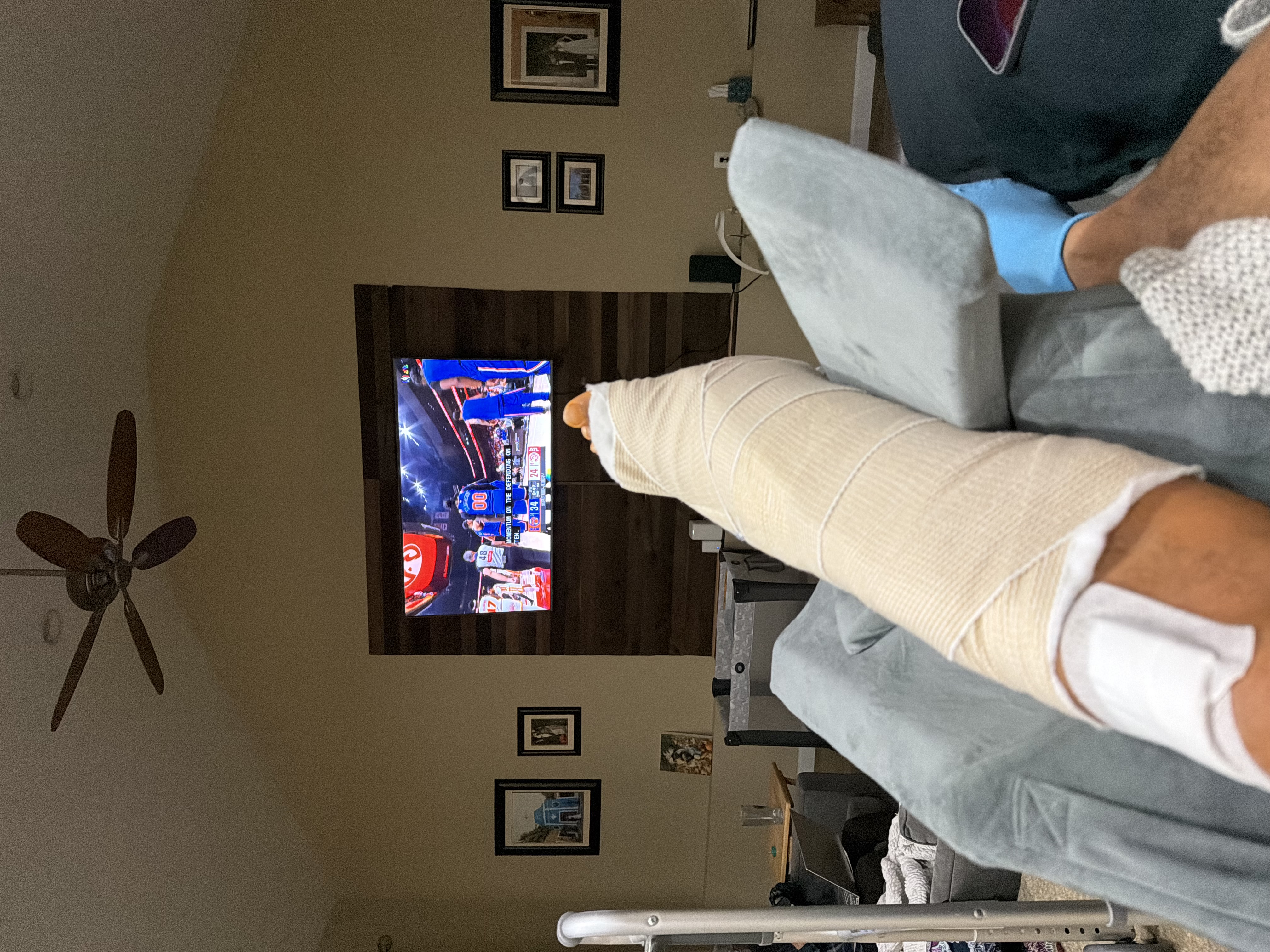
I was on a couch with my leg wrapped from the toe to the knee, a walker parked next to the armrest, the Knicks on the television, and a glass of water on the side table I could not get up to refill. CNN cut in with the breaking banner about three quarters of the way through the second quarter.
The chair I would have sat in is one of the chairs the room hit the floor under.
I have spent twenty years showing up to rooms like that one. I have done the cocktail hour. I have done the head table. I have shaken the hands the Saturday letter was about. I know the math of who eats with whom and which photograph gets reposted at midnight.
I know what I would have done last night.
I would have stood up because the people next to me stood up. I would have crouched because the agent at my table told me to crouch. I would have looked for my wife. I would have looked for the door. I would have done what everybody else in that room did, which is the thing you do not get to plan in advance.
I have never been so happy to be at home.
That is not a punchline. It is the sentence I keep coming back to. The chair I was supposed to sit in tonight became a chair somebody crawled under. Weijia Jiang said it on the record at the post-shooting press conference: “I crawled to the ground as quickly as possible.” The night I was supposed to be working became the night the country watched a security checkpoint exchange fire on live television. The dinner I was going to write about from the inside became the dinner I had to cover from the outside, with my foot up, on a couch, in a house with my daughter asleep upstairs.
The president of the White House Correspondents’ Association did not get to finish the program she rehearsed.
I did not get to attend the program she rehearsed.
She did the more important thing anyway.
So did the rest of the people who stayed in that room until the agents told them to leave.
Fragment Verdict
The dinner was a shit show. The speech wasn’t. The seating chart is a confession.
Number of the Day
8:40 p.m. — The first shot. 9:39 p.m. — The first speech. 30 days — The deadline to do it again, on purpose.
Quote of the Day
“I said earlier tonight that journalism is a public service, because when there is an emergency, we run to the crisis, not away from it. And on a night when we are thinking about the freedoms and the First Amendment, we must also think about how fragile they are.” — Weijia Jiang, WHCA President, from the stage at the Washington Hilton, April 25, 2026
“Speak forcefully, in front of the man who seeks to undermine our country’s long tradition of an independent, strong, and free press.” — from the open letter signed by Dan Rather, Sam Donaldson, Ann Curry, and more than 250 other journalists, April 20, 2026
The letter asked for a forceful defense. It got one. The room it was delivered in is a different room than the letter pictured. The line is not.
Coming Next
Monday: The Stock Ban Senator. Forty-four days. Fifty-seven trades. $2.2 million. One bill. Her name is Ashley Moody.
Closing Verdict
The press did not get to defend itself at a podium last night.
The letter got an answer anyway.
It came at 9:39 p.m. Eastern, off-script, from a stage that had been evacuated an hour earlier, in a building with a man bleeding into a hospital gurney one floor down.
The dinner was a shit show. The speech wasn’t. The seating chart is a confession. The country’s distrust is the shit storm.
The next dinner is in 30 days.
That one we get to grade on purpose.
This one is built to forward.
Drop your email and the next receipt lands where you can actually use it.
Receipts in this issue
Already on the list? Send this to one person who reads the fine print.
New here? Subscribe from this issue so the dashboard can count the public funnel, not just imports.