Make the Map Knock on Doors
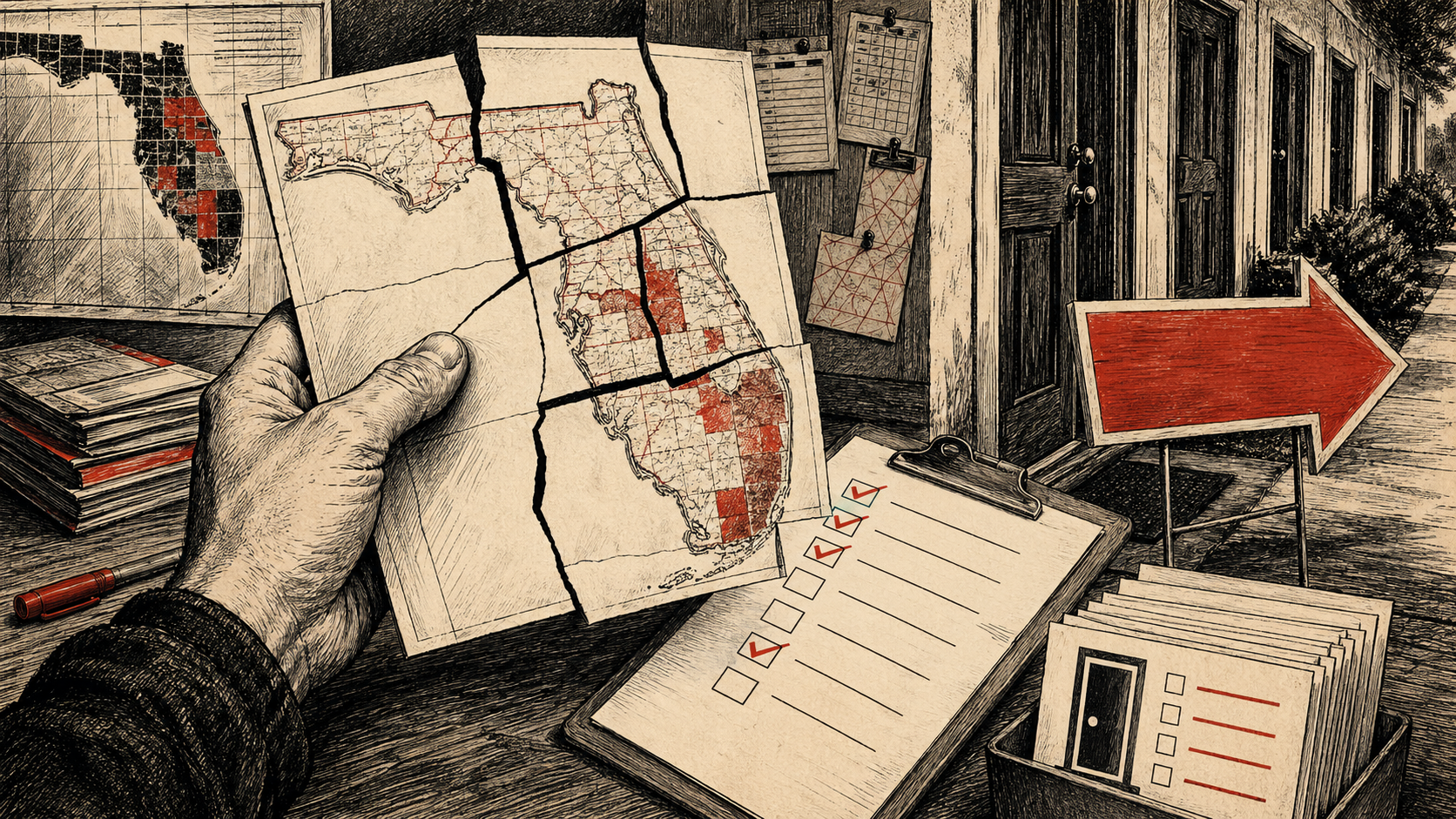
A stolen map is not an abstract democracy story. It is a field universe.
Make the Map Knock on Doors
The first mistake is calling this a democracy issue and stopping there.
It is a democracy issue. Of course it is. But that phrase has been worn so thin in political language that too many voters hear it as a weather report. Something bad is happening somewhere above them. Something serious people are concerned about. Something lawyers and cable panels will discuss until the next emergency arrives.
That is not enough for Florida.
The DeSantis map has to become a local campaign problem for every Republican who voted for it, every Republican who benefits from it, and every Republican who tries to hide behind the phrase “legal landscape.”
The field plan is simple:
Make the map knock on doors.
Do not begin with the Supreme Court. Begin with the voter. Begin with the city. Begin with the county. Begin with the representative who was functionally targeted. Begin with the neighbor who shares a school board, a bridge, a storm evacuation route, and a hospital system with one community, but would be assigned to a different congressional fight under the approved map.
The message is not “redistricting is bad.”
The message is: “They split your city in forty-eight hours.”
The message is: “They carved your county so they could get four more Republican seats.”
The message is: “They targeted your representative without beating them at the ballot box.”
The message is: “They did not ask Florida voters for 24-4. They drew it.”
Every campaign tactic should flow from that.
Start with a map-theft index. Every Florida Democratic campaign, outside group, state legislative caucus, and democracy organization should publish one page for each affected media market. No legal essay. No long PDF. A clean civic indictment.
Tampa Bay:
Tampa split across Districts 12, 14, and 15. St. Petersburg split across Districts 13 and 16. Pinellas split across Districts 13 and 16. Hillsborough split across Districts 12, 14, and 15. Pasco split across Districts 12, 13, and 15.
South Florida:
Fort Lauderdale split across Districts 20 and 25. Hollywood split across Districts 24, 25, and 26. Miramar split across Districts 24 and 26. Pembroke Pines split across Districts 24 and 26. Miami split across Districts 24 and 27. North Miami split across Districts 24 and 25. North Miami Beach split across Districts 24 and 25.
Central Florida:
Orange County split across Districts 8, 9, 10, and 11. Orlando appears in Districts 8, 9, 10, and 11 in the Senate packet, including tiny fragments that make the point almost too well: five Orlando residents in District 8, 45,087 in District 9, 261,311 in District 10, and 1,170 in District 11. That is not a community story. That is a sorting mechanism.
Palm Beach:
Palm Beach County split across Districts 21, 22, 23, and 25. West Palm Beach split across Districts 21 and 23. Delray Beach split across Districts 23 and 25. Riviera Beach split across Districts 21 and 23. Royal Palm Beach split across Districts 21 and 22.
That is the first product. Put it on a website. Put it in mail. Put it in every local press pitch. Put it in Spanish, Haitian Creole, and any other language relevant to the target communities. Print it as a one-page handout for churches, senior centers, union halls, campus clubs, barbershops, neighborhood associations, and local Democratic clubs.
Second, build the 48-hour accountability script.
The strongest line in this fight is not “the courts.” It is “Monday to Wednesday.”
On Monday, DeSantis transmitted the map. On Tuesday, the special session began. On Wednesday, Republicans passed it. AP/Local10 reported the vote totals: 83-28 in the House, 21-17 in the Senate.
Every Republican answer should be dragged back to that timeline.
“Why did you need to split Tampa into three congressional districts in forty-eight hours?”
“Why did you vote on a map two days after the governor unveiled it?”
“Why did Floridians get thirty seconds of public comment on a map meant to shape congressional power?”
“Why should voters believe this was about population growth when AP reported the map could move Florida from 20-8 to 24-4?”
“Did you ask your constituents whether they wanted their city divided before you voted yes?”
That is the question set. Use it everywhere.
Then localize it by chamber.
For state legislators who voted yes, the question is direct: “Did you read the city-split table before you voted?” Do not ask whether they support fair maps. They have an answer for that. Ask whether they knew Tampa was split three ways. Ask whether they knew St. Petersburg was split two ways. Ask whether they knew Miami, Fort Lauderdale, Hollywood, Miramar, Pembroke Pines, North Miami, North Miami Beach, Delray Beach, West Palm Beach, Riviera Beach, Plantation, Sunrise, Pompano Beach, and Davie appear in divided form in the state packet.
For congressional Republicans, the question is ownership: “Will you campaign under a map designed to move Florida from 20-8 to 24-4?” Do not let them answer with litigation. They are not judges. They are candidates. Ask them whether they want the seat under those rules.
For county Republicans, the question is service: “How does carving this county help hurricane recovery, transportation, flood insurance, schools, veterans, or federal grants?” If they cannot answer that, they have admitted the map was not about representation. It was about control.
Third, force beneficiary ownership.
Do not only target the state legislators who voted yes. Target the congressional Republicans who benefit. Every benefited member should be asked one local question, not one generic democracy question.
“Do you support the map that splits St. Petersburg?”
“Do you support the map that divides Fort Lauderdale?”
“Do you support the map that places Miami voters into multiple congressional seats to build a 24-4 delegation?”
“Do you support the map that could eliminate Democratic representation around Tampa Bay?”
Make them answer the consequence, not the slogan.
Fourth, stop treating litigation as the communications plan.
Litigation is one lane. It is not the campaign. Any legal challenge could take months. The public meaning of the map will be formed in days. Republicans understand this. That is why speed matters. A rushed map is not only a procedural sin. It is a communications weapon. Pass it fast enough and everyone else spends the first week explaining what happened.
Do not spend the first week explaining.
Accuse.
Then prove.
The proof is in the state packet. The proof is in AP/Local10. The proof is in the vote totals. The proof is in the city splits. The proof is in the 24-4 target. The proof is in the sponsor saying she could not speak to the intent of the map drawer after questions about party affiliation and voting patterns.
The communications order matters.
Day one is not “we are reviewing legal options.” Day one is “they split your city.” Day one is not “we will fight this in every venue.” Day one is “here is your old district, here is your new district, here is the Republican who voted to change it.” Day one is not “we disagree with the Legislature’s interpretation of recent Supreme Court precedent.” Day one is “they took two days to pass a map that could hand themselves four seats.”
Lawyers should file. Campaigns should indict.
Fifth, build district-specific earned media.
The wrong press conference is a podium full of statewide figures saying democracy is under attack. The right press conference is three Tampa residents from three districts on the approved map standing at the same intersection asking why one city was turned into three congressional stories.
The wrong op-ed is “Florida’s redistricting threat to democracy.” The right op-ed is “Why did Tallahassee split St. Petersburg?”
The wrong cable hit is a legal debate about Section 2. The right cable hit is a map board showing the Monday-to-Wednesday timeline and the 20-8 to 24-4 jump.
Every local hit should have one map, one number, one question.
Map: the city split.
Number: 48 hours or 24-4.
Question: “Why did they do this before voters could object?”
Use the same discipline for earned media lists.
Tampa Bay outlets get Tampa, St. Petersburg, Hillsborough, Pinellas, and Pasco. South Florida outlets get Miami, Fort Lauderdale, Hollywood, Miramar, Pembroke Pines, Broward, Miami-Dade, and Palm Beach. Central Florida outlets get Orange County and Orlando. Spanish-language outlets get Miami-Dade and Central Florida examples first, not as an afterthought. Black radio gets the AP line about the nearly majority Black South Florida district effectively eliminated, plus local voter voices, not a national surrogate reading talking points.
The story has to arrive in the geography it is accusing.
Sixth, convert the map into organizing universes.
The approved districts are not only lines. They are lists. They tell campaigns where outrage is likely to be concrete. Build voter-contact universes around carved communities:
Voters in split cities.
Voters in counties divided into three or more congressional districts.
Voters represented by a Democrat under the old map whose district is now functionally changed or weakened.
Black voters in and around the nearly majority Black South Florida district AP/Local10 says was effectively eliminated.
Latino voters in Miami-Dade and Central Florida whose districts were reshaped while Republicans claim a neutral process.
Unaffiliated voters who dislike politicians choosing voters.
Veterans and military families who can be reached through the Rob Woods frame from AP/Local10: the promise of equal-opportunity democracy being pulled backward.
Each universe gets a different door script.
For split-city voters:
“Your city was divided in the new map. Did anyone ask you before Tallahassee voted?”
For county-carve voters:
“Your county is now divided across multiple congressional districts. That makes it harder to hold one representative accountable for local needs.”
For targeted-representation voters:
“They could not beat your representative at the ballot box, so they changed the district.”
For unaffiliated voters:
“You do not have to be a Democrat to hate politicians picking their voters.”
For Black voters in affected districts:
“They call it race-neutral. AP reported it effectively eliminates a nearly majority Black South Florida district.”
Build the field tools like a campaign that expects voters to ask real questions.
Every canvasser needs a one-page “what changed here” sheet. It should show the old district, the new district, the Republican vote, the local split, and a QR code to the source packet. Every phone banker needs a clean answer when a voter says, “I thought the Supreme Court did this.” The answer is: “The Supreme Court changed the legal environment. Florida Republicans still chose this map, this fast, with these local consequences.”
Every candidate needs a thirty-second version:
“This is not about whether lines move after a census. This is about a governor sending a map Monday and legislators passing it Wednesday to turn 20-8 into 24-4. In our community, that means [local city/county split]. That is why I am running.”
That sentence can be spoken at a door, in a debate, on local radio, or in a television hit.
Seventh, make every mail piece look like a receipt.
Do not send glossy consultant mail with a dramatic photo of DeSantis. Send a clean newspaper-style card:
Front: “THEY SPLIT TAMPA IN 48 HOURS.”
Back: the three district numbers, the Tampa population counts from the Senate packet, the House and Senate vote totals, and the name of the local Republican who voted yes or benefits.
Front: “ST. PETERSBURG WAS DIVIDED. ASK THEM WHY.”
Back: District 13: 88,616. District 16: 169,692. Source: Florida Senate redistricting data packet.
Front: “FORT LAUDERDALE DID NOT MOVE. THE MAP DID.”
Back: District 20: 102,630. District 25: 80,130. Source: Florida Senate redistricting data packet.
That is how you make the abstract touch pavement.
Digital should follow the same rule.
No generic graphic of a cracked map. No “save democracy” banner. No solemn stock photo of the Capitol. Build share cards that carry one local receipt each:
“MIAMI WAS SPLIT. DISTRICT 24: 153,074. DISTRICT 27: 289,167.”
“HOLLYWOOD WAS SPLIT THREE WAYS.”
“PALM BEACH COUNTY WAS CUT INTO FOUR CONGRESSIONAL DISTRICTS.”
“BROWARD WAS CUT INTO FIVE.”
Each card should name the source. Each caption should ask one question. Each post should tag the local Republican or beneficiary who owes an answer.
Eighth, create a Republican answer tracker.
One public page. Every Republican state legislator. Every Florida Republican member of Congress. Three columns:
Did they support the 48-hour map?
Did they explain why their community was split or carved?
Did they agree to hold a public town hall in an affected city?
This is not complicated. That is why it works.
Add a public clock.
Not a countdown to Election Day. A count-up from the map’s transmission. “Hours since DeSantis sent the map.” “Hours since the vote.” “Days without a town hall.” “Days without an explanation for Tampa.” “Days without an explanation for St. Petersburg.” It sounds theatrical because politics is theater with material consequences. Use the theater.
Ninth, prepare the dummymander argument without sounding smug.
AP/Local10 noted the possibility that aggressive GOP maps can spread Republican voters thin enough to create risk in a backlash year. Democrats should not lead with that because it sounds like a consultant whispering to another consultant. But internally, campaigns should model it ruthlessly.
If Republicans are stretching a 20-8 map to 24-4, they are creating districts that may be less secure than they look in a normal year. The field opportunity is not just persuasion. It is turnout among voters who understand they were manipulated.
The strongest revenge against a gerrymander is not a clever tweet. It is a door knocked in the piece of the city they assumed would be quiet.
That means campaigns should invest where the map assumes passivity.
Find the districts where the Republican baseline is newly manufactured but not culturally settled. Find the precincts where voters were moved from a familiar incumbent into a colder district. Find the suburbs where unaffiliated voters dislike procedural rigging even when they are not Democratic loyalists. Find the Black and Latino communities that have been told the map is neutral while their political power is being diluted into a statewide partisan project.
The map is a memo from the other side. Read it that way.
Tenth, keep the moral language plain.
Do not say “democracy is on the ballot.” Say “They drew four seats before you voted.”
Do not say “partisan gerrymandering undermines representational fairness.” Say “They split your city to protect themselves.”
Do not say “this is an assault on democratic norms.” Say “They took a 20-8 map and tried to make it 24-4.”
The public is not confused because it lacks values. It is exhausted because politics keeps hiding simple corruption inside professional language.
So do not hide it.
This is map theft. Treat it like theft.
Name the thing taken. Name the person who took it. Name the place it was taken from. Name the person who benefited. Put the receipt in the voter’s hand. Ask for a response.
The final tactic is repetition without apology.
Say “48-hour map” until reporters use it.
Say “20-8 to 24-4” until voters can repeat it.
Say “they split your city” until Republicans have to deny the state packet.
Say “the courts did not make you vote yes” until every dodge sounds like a confession.
That is how a structural theft becomes a campaign issue. Not by hoping voters spontaneously care about district design. By making the design visible where they live.
That is the campaign.
Make the map knock on doors.